Home / Azure

Tool | Azure Virtual Desktop Documenter

Tool | Azure Virtual Desktop Documenter


Reading Time: 2 minutes

Azure Virtual Desktop (AVD) is incredibly powerful, but let’s be honest: once your environment grows beyond a handful of host pools, staying on top of configuration, dependencies, and compliance quickly becomes a challenge.
How many host pools do you have? Which image is used where? Are session hosts configured consistently? And, most importantly, could you prove all of that to an auditor, security team, or customer tomorrow?

This is exactly the problem Documenter for Azure Virtual Desktop was built to solve.
Image

The real problem with AVD documentation

In theory, Azure gives us everything we need. In practice, AVD environments tend to grow organically over time:

  • Multiple host pools for different workloads
  • Different images per environment or region
  • A mix of personal and pooled desktops
  • Scaling plans, application groups, networking, identity… all interconnected

Documentation often ends up being:

  • Outdated
  • Manually written in Word or Wiki pages
  • Incomplete or inconsistent
  • Entirely missing for “temporary” test environments that became permanent

And when you need that documentation, during an incident, audit, migration, or handover, it’s usually too late.

Introducing Documenter for Azure Virtual Desktop

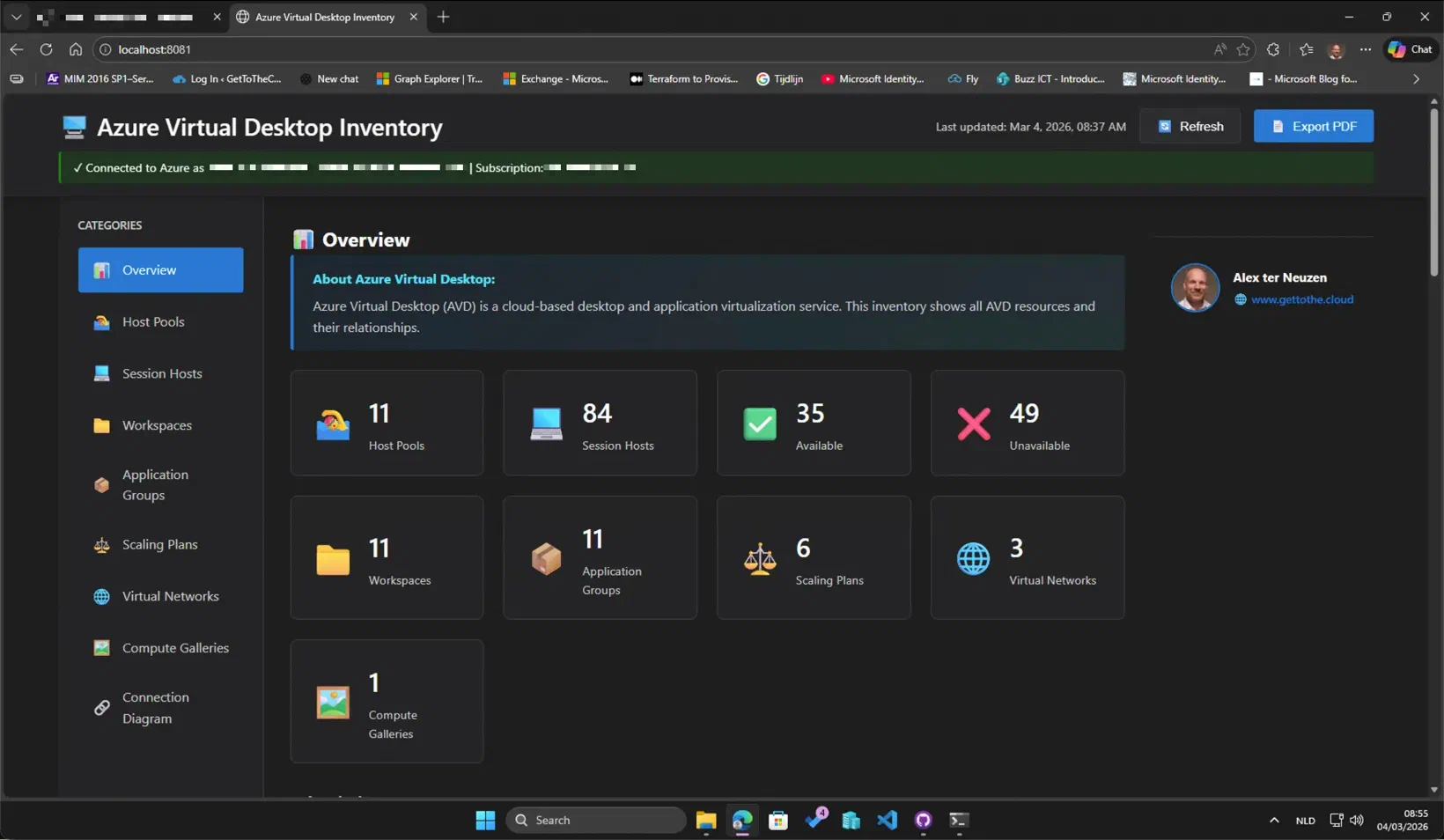
Documenter for Azure Virtual Desktop is an open-source PowerShell-based solution that automatically inventories your AVD environment and turns it into structured, readable documentation.

Instead of manually tracking changes, the tool queries Azure directly and produces a consistent overview of your entire AVD landscape, based on what is actually deployed, not what someone thinks is deployed.

It’s built for consultants, platform engineers, and operations teams who want clarity, repeatability, and evidence.

Built for automation-first teams

Documenter for Azure Virtual Desktop fits naturally into modern workflows:

  • Run it on-demand before changes
  • Schedule it as part of recurring audits
  • Integrate outputs into project documentation
  • Use it as evidence during handovers or regulator discussions

Because it’s script-based and open-source, you stay in control, no black boxes, no vendor lock-in.

Azure Virtual Desktop isn’t “just another Azure service.”
It’s a user-facing platform with security, cost, and availability implications—and it deserves proper documentation.

Documenter for Azure Virtual Desktop helps you move from assumptions to evidence, from manual effort to automation, and from fragmented knowledge to clarity.

If you’re serious about operating AVD professionally, this is a tool you’ll want in your toolbox.

👉 Explore https://www.azuredocumenter.com

Share and Enjoy !

Shares

Designer (23)

Stay close to the action—follow GetToThe.Cloud across social!
Deep dives and hands‑on how‑tos on Azure Local, hybrid cloud, automation, PowerShell/Bicep, AVD + FSLogix, image pipelines, monitoring, networking, and resilient design when the internet/Azure is down.

🔗 Our channels
▶️ YouTube: https://www.youtube.com/channel/UCa33PgGdXt-Dr4w3Ub9hrdQ
💼 LinkedIn Group: https://www.linkedin.com/groups/9181126/
✖️ X (Twitter): https://x.com/Gettothecloud
🎵 TikTok: https://www.tiktok.com/@gettothecloud
🐙 GitHub: https://github.com/GetToThe-Cloud/Website
💬 Slack: DM us for an invite
📲 WhatsApp: DM for the community link

We use cookies to personalise content and ads, to provide social media features and to analyse our traffic. We also share information about your use of our site with our social media, advertising and analytics partners. View more
Cookies settings
Accept
Privacy & Cookie policy
Privacy & Cookies policy
Cookie name Active

Who we are

Our website address is: https://www.gettothe.cloud

Comments

When visitors leave comments on the site we collect the data shown in the comments form, and also the visitor’s IP address and browser user agent string to help spam detection.An anonymized string created from your email address (also called a hash) may be provided to the Gravatar service to see if you are using it. The Gravatar service privacy policy is available here: https://automattic.com/privacy/. After approval of your comment, your profile picture is visible to the public in the context of your comment.

Media

If you upload images to the website, you should avoid uploading images with embedded location data (EXIF GPS) included. Visitors to the website can download and extract any location data from images on the website.

Cookies

If you leave a comment on our site you may opt-in to saving your name, email address and website in cookies. These are for your convenience so that you do not have to fill in your details again when you leave another comment. These cookies will last for one year.If you visit our login page, we will set a temporary cookie to determine if your browser accepts cookies. This cookie contains no personal data and is discarded when you close your browser.When you log in, we will also set up several cookies to save your login information and your screen display choices. Login cookies last for two days, and screen options cookies last for a year. If you select "Remember Me", your login will persist for two weeks. If you log out of your account, the login cookies will be removed.If you edit or publish an article, an additional cookie will be saved in your browser. This cookie includes no personal data and simply indicates the post ID of the article you just edited. It expires after 1 day.

Embedded content from other websites

Articles on this site may include embedded content (e.g. videos, images, articles, etc.). Embedded content from other websites behaves in the exact same way as if the visitor has visited the other website.These websites may collect data about you, use cookies, embed additional third-party tracking, and monitor your interaction with that embedded content, including tracking your interaction with the embedded content if you have an account and are logged in to that website.

Who we share your data with

If you request a password reset, your IP address will be included in the reset email.

How long we retain your data

If you leave a comment, the comment and its metadata are retained indefinitely. This is so we can recognize and approve any follow-up comments automatically instead of holding them in a moderation queue.For users that register on our website (if any), we also store the personal information they provide in their user profile. All users can see, edit, or delete their personal information at any time (except they cannot change their username). Website administrators can also see and edit that information.

What rights you have over your data

If you have an account on this site, or have left comments, you can request to receive an exported file of the personal data we hold about you, including any data you have provided to us. You can also request that we erase any personal data we hold about you. This does not include any data we are obliged to keep for administrative, legal, or security purposes.

Where we send your data

Visitor comments may be checked through an automated spam detection service.
Save settings
Cookies settings