
Azure Active Directory Assessment | Part I

Header tenantassesment
Reading Time: 2 minutes

Setting up Azure Active Directory is one thing, but managing is a whole other thing. With multiple administrators it is hard to keep the Azure Active Directory

Multiple administrators are instructed often how to use a name convention or how to use create groups or users. Mostly they are in a rush and doing administrator tasks on the spot, without maintaining the guidelines.

The creation of App registrations is by default enabled for all users and as an administrator you will not get a notify of that. Applications need permissions to access the Azure Active Directory and it is not audited. Clicking in the portal is a way to go but wouldn’t it be nice if you just run a script and get a detailed report about it.

What to assess

Getting reports from Azure Active Directory is getting a lot of information. A lot of information to process and to review. I Personally would like the following information:

  • Users (Member/ADSynced/Guest) and their attributes
  • Groups (Security/Distribution/Unified) and their attributes and members
  • Licensing (Assignments/enabled)
  • Organization Details
  • App registrations with Token lifetime/certificate lifetime
  • Azure AD Roles included members and if are eligible (Azure P2 license)
  • Conditional Access policies and settings
  • Devices (Registered/AAD Joined)

Enable M365 option

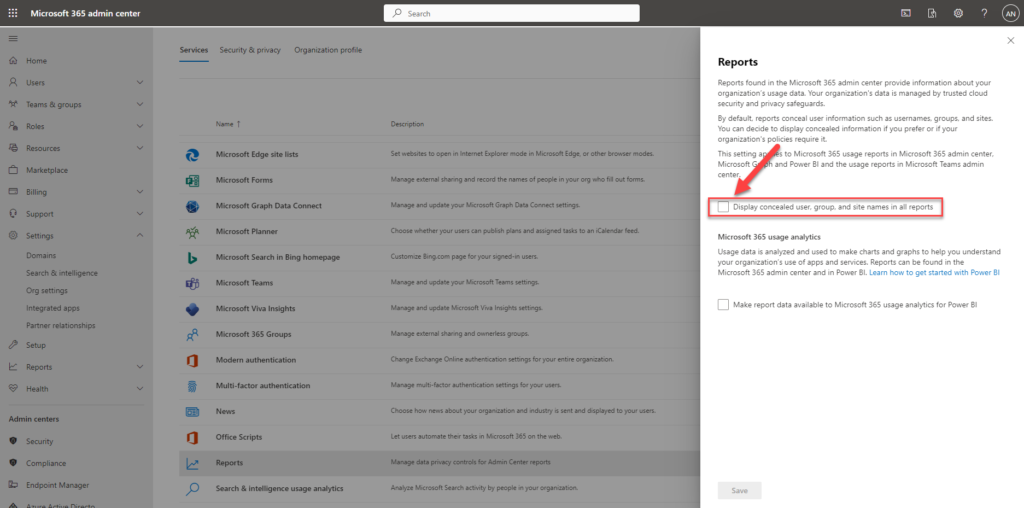
By default the reports from M365 do not have any personal information. userPrincipalName en DisplayName are random numbers in a report. To avoid that you have to disable a checkbox in the portal.

Browse to : https://admin.microsoft.com/#/Settings/Services/:/Settings/L1/Reports
How to get the information

I Use Microsoft Graph API to get the information. The cmdlets within Azure PowerShell modules are going to be deprecated within time and the Graph API will remain.

To use the Graph API, you will need an App registration with the correct permissions. Application assigned permissions we are going to use:

user.read.all (application)directory.read.all (application)
group.read.all (application)application.read.all (application)
auditlog.read.all (application)orgcontact.read.all (application)
policy.read.all (application)userauthenticationmethod.read.all (application)
reports.read.all (application)rolemanagement.read.all (application)
rolemanagement.read.directory (application)identityriskevent.read.all (application)
device.read.all (application)identityprovider.read.all (application)
organization.read.all (application) 

To get to know which permissions are needed, you will find them in the reference guide at the Microsoft docs or using the Graph API explorer.

Also you will need the URL from Graph API to get the correct information. A good way to start is the Graph Explorer and login with your admin credentials.

In the next post, an App registration will be created with the correct permissions. The credentials and connection details will be saved to the Desktop of the user that is creating the app. The app registration will not use a certificate, but is using a client_secret so it can be run on another computer as well.

Share and Enjoy !

Shares
Designer (23)

Stay close to the action—follow GetToThe.Cloud across social!
Deep dives and hands‑on how‑tos on Azure Local, hybrid cloud, automation, PowerShell/Bicep, AVD + FSLogix, image pipelines, monitoring, networking, and resilient design when the internet/Azure is down.

🔗 Our channels
▶️ YouTube: https://www.youtube.com/channel/UCa33PgGdXt-Dr4w3Ub9hrdQ
💼 LinkedIn Group: https://www.linkedin.com/groups/9181126/
✖️ X (Twitter): https://x.com/Gettothecloud
🎵 TikTok: https://www.tiktok.com/@gettothecloud
🐙 GitHub: https://github.com/GetToThe-Cloud/Website
💬 Slack: DM us for an invite
📲 WhatsApp: DM for the community link

We use cookies to personalise content and ads, to provide social media features and to analyse our traffic. We also share information about your use of our site with our social media, advertising and analytics partners. View more
Cookies settings
Accept
Privacy & Cookie policy
Privacy & Cookies policy
Cookie name Active

Who we are

Our website address is: https://www.gettothe.cloud

Comments

When visitors leave comments on the site we collect the data shown in the comments form, and also the visitor’s IP address and browser user agent string to help spam detection. An anonymized string created from your email address (also called a hash) may be provided to the Gravatar service to see if you are using it. The Gravatar service privacy policy is available here: https://automattic.com/privacy/. After approval of your comment, your profile picture is visible to the public in the context of your comment.

Media

If you upload images to the website, you should avoid uploading images with embedded location data (EXIF GPS) included. Visitors to the website can download and extract any location data from images on the website.

Cookies

If you leave a comment on our site you may opt-in to saving your name, email address and website in cookies. These are for your convenience so that you do not have to fill in your details again when you leave another comment. These cookies will last for one year. If you visit our login page, we will set a temporary cookie to determine if your browser accepts cookies. This cookie contains no personal data and is discarded when you close your browser. When you log in, we will also set up several cookies to save your login information and your screen display choices. Login cookies last for two days, and screen options cookies last for a year. If you select "Remember Me", your login will persist for two weeks. If you log out of your account, the login cookies will be removed. If you edit or publish an article, an additional cookie will be saved in your browser. This cookie includes no personal data and simply indicates the post ID of the article you just edited. It expires after 1 day.

Embedded content from other websites

Articles on this site may include embedded content (e.g. videos, images, articles, etc.). Embedded content from other websites behaves in the exact same way as if the visitor has visited the other website. These websites may collect data about you, use cookies, embed additional third-party tracking, and monitor your interaction with that embedded content, including tracking your interaction with the embedded content if you have an account and are logged in to that website.

Who we share your data with

If you request a password reset, your IP address will be included in the reset email.

How long we retain your data

If you leave a comment, the comment and its metadata are retained indefinitely. This is so we can recognize and approve any follow-up comments automatically instead of holding them in a moderation queue. For users that register on our website (if any), we also store the personal information they provide in their user profile. All users can see, edit, or delete their personal information at any time (except they cannot change their username). Website administrators can also see and edit that information.

What rights you have over your data

If you have an account on this site, or have left comments, you can request to receive an exported file of the personal data we hold about you, including any data you have provided to us. You can also request that we erase any personal data we hold about you. This does not include any data we are obliged to keep for administrative, legal, or security purposes.

Where we send your data

Visitor comments may be checked through an automated spam detection service.
Save settings
Cookies settings